• About Us
    • About us
    • Careers
    • People
  • Services
    • Inclusive Cultures
    • Inclusive Recruitment
    • Inclusive Development
  • Resources
    • Insights
    • Research
    • Press
  • Case Studies
  • Contact Us
  • About Us
    • About us
    • Careers
    • People
  • Services
    • Inclusive Cultures
    • Inclusive Recruitment
    • Inclusive Development
  • Resources
    • Insights
    • Research
    • Press
  • Case Studies
  • Contact Us
Search
Contact us
Menu

Home › Insights › And how are you making others feel today?

And how are you making others feel today?

Stuart Duff
Stuart Duff is a Partner and Head of Development at Pearn Kandola. He is a chartered business psychologist who specialises in Management Development, Leadership and Coaching.
  • April 20, 2015
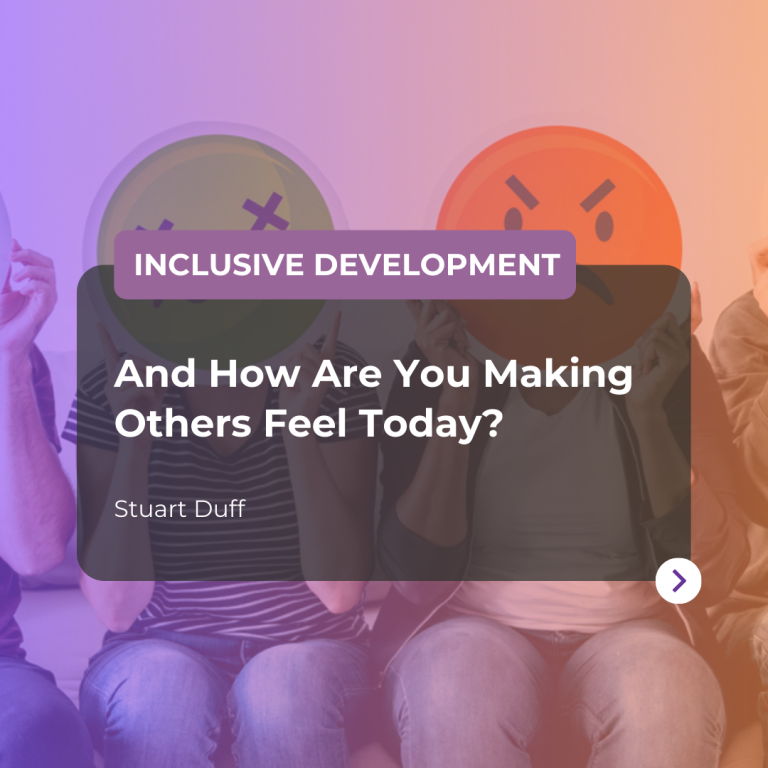
And How Are You Making Others Feel Today? article promo image

An important ingredient in successful coaching is self-awareness. In fact it could be argued that it is the most important step towards successful coaching and that, without it, any positive impact of the coaching will be negligible and short-lived. I would go so far as to suggest that self-awareness is core to our behaviour, a control centre that monitors and regulates our interactions and our effectiveness in all walks of life, not least in managing and leading others.

In coaching, when you ask people how they feel, the vast majority of people will have a reasonably clear and articulate response. They may be happy, sad, frustrated, annoyed, excited and so on.

But the real challenge emerges when you ask people to describe how they make others feel. While some may be switched on to this, far fewer people are able to clearly express how they make others feel.

A recent paper in the European Journal of Personality builds on research into what’s known as ‘affective presence’. This is the extent to which we elicit emotions in others. Several different studies suggest that this is a trait that we all share – much like assertiveness or sociability – and that it varies between us.

To understand affective presence, the researchers measured the way that people consistently left others feeling over the course of several interactions. These feelings were then rated and the scores were correlated with other trait characteristics.

What did they find? Most importantly, the strength of our affective presence has a marked positive (or negative) impact on the degree to which: we connect with others; we leave others feeling positive; and the extent to which we enthuse and motivate others. Interestingly individuals with higher levels of affective presence also have higher levels of emotional regulation (they manage their reactions in pressured situations) and have higher emotional expressiveness (they share how they are feeling). They also have significantly higher levels of agreeableness.

So what? Well, if affective presence is a trait then it will be measurable. If it’s measurable, then it may provide useful feedback and insights that will be helpful in coaching and development to raise self-awareness. And in the process, it may be one of the keys to developing greater self-awareness over a long period of time and, with it, greater leadership effectiveness.
Stay ahead of the game.

Get the latest on DEI, effective recruitment, and leadership development direct to your inbox.
This field is for validation purposes and should be left unchanged.
Privacy policy(Required)

Related Posts

  • Inclusive Development, Webinars

New Webinar: Inclusive Talent Management – Developing the Developers

Inclusive Talent Management: Developing the Developers Hosted by Jonathan Taylor4th September 2025 Join us for an exploration of how to...
Image showing the psychological safety week, pearn kandola and financial times logos with the heading 'Live Sessions'
  • Inclusive Cultures, Inclusive Development, Inclusive Recruitment

Psychological Safety Week Live Events Announced

We are delighted to share the core live event agenda for Psychological Safety Week, a new international initiative created and...
  • Inclusive Development, Webinars

New Webinar: Unlocking Leadership Potential – The Psychology Behind High Impact Business Coaching

Join us for an exploration of how business psychology can elevate leadership and executive coaching to deliver tangible outcomes for...
  • Inclusive Cultures, Inclusive Development, Webinars

Exclusive Pride Month Webinar Series with Professor Binna Kandola OBE

Exclusive Pride Month Webinar Series Hosted by Professor Binna Kandola OBE24th & 25th June 2025 Join us for a thought-provoking,...
  • Inclusive Development, Webinars

New Webinar: Rethinking DEI: Talent Management – Friend or Foe?

In this interactive webinar, Professor Binna Kandola OBE, Senior Partner and Founder of Pearn Kandola explores the three pillars that...
  • Inclusive Development

Designing for Diversity Launches Today

We’re delighted to share that the first of three books written by our Co-founder and Senior Partner, Professor Binna Kandola...

Free Consultation with a Business Psychologist

Talk to us to discuss your needs.
Book an Appointment
14 years’ experience
Jonathan Taylor, Managing Psychologist

Book Your Appointment Today

This field is for validation purposes and should be left unchanged.
(Required)
Terms & Conditions

Privacy Policy

Cookie Policy

Site map

Making The World Fairer

© 2025 Pearn Kandola LLP

© 2015-2024 Pearn Kandola LLP. All Rights Reserved.
Pearn Kandola and the Pearn Kandola Logo are registered trademarks of Pearn Kandola LLP.

  • About Us
    • About us
    • Careers
    • People
  • Services
    • Inclusive Cultures
    • Inclusive Recruitment
    • Inclusive Development
  • Resources
    • Insights
    • Research
    • Press
  • Case Studies
  • Contact Us
Search