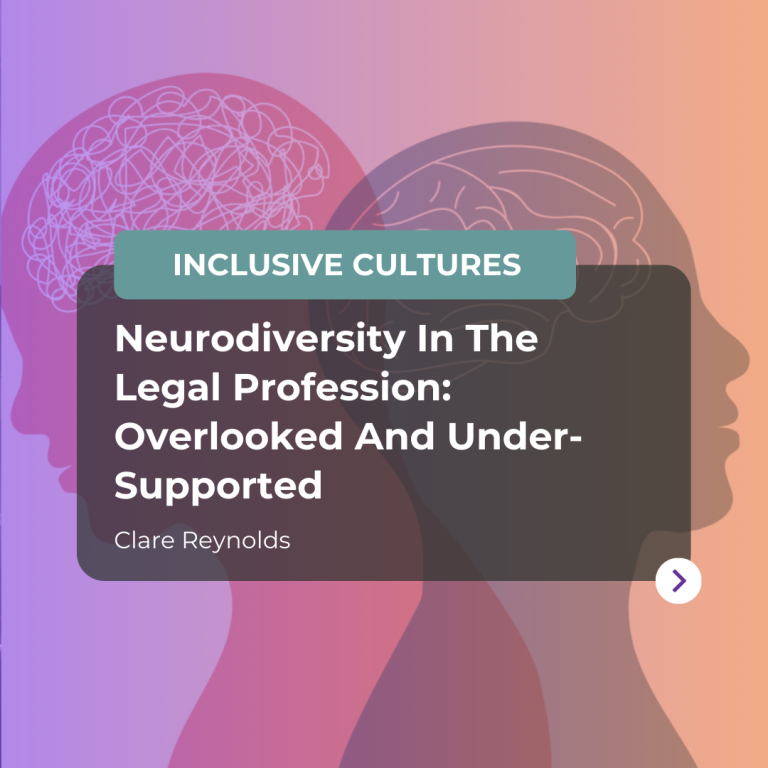
Neurodiversity has become a buzzword in recent years as companies recognise the competitive advantages of a diverse workforce.
However, a recent study showed a shocking 59% of neurodivergent employees feel unsupported in the workplace, despite 87% of companies saying that they’re prioritising neurodiversity.
Following on from my article on 3 Ways to Support Your Neurodivergent Colleagues, I’ve been looking at the support available to neurodivergent employees in the legal sector.
Why? The lack of support is evident in the legal profession, where only 20% of law firms have a disability inclusion action plan alongside their Diversity and Inclusion policies.
This failure to support the neurodiverse population in the legal profession can have serious consequences.
How a lack of support can impact a neurodivergent individual
The effects of a lack of support were made clear to me during one of my first sessions as a neurodiversity coach. I was coaching an autistic man with Auditory Processing Disorder (APD) who was diagnosed very late in his career.
Despite being highly intelligent – and at the top of his organisation – his APD meant he could only process the first few words of every sentence. In our first session, he attempted to storm out, believing he couldn’t be helped due to years of inadequate support.
We tackled this understandable anger and frustration at his past experiences and found a way to work together. In fact, after just five coaching sessions, he was in a much better place. But this example shows the cumulative toll a lack of understanding and support can have on employees.
So the first step we can take to support neurodivergent employees is to try and understand the strengths and challenges associated with each condition.
Understanding the strengths and challenges for neurodivergent employees
Autism
- Strengths: Attention to detail, analytical thinking, out-of-the-box problem-solving skills, expertise in niche areas, and tech-savviness.
- Challenges: Sensitivity to sensory stimuli, difficulty with uncertainty and change, and stress from social interactions.
ADHD
- Strengths: Creativity, out-of-the-box thinking, high energy, and adaptability to change.
- Challenges: Difficulty maintaining focus, poor time management, hyperactivity, and difficulty recalling important information.
Dyslexia
- Strengths: Verbal communication skills, exceptional long-term memory, and simplification of complex concepts.
- Challenges: Reading fluency and comprehension, spelling and grammar, and time management.
Dyspraxia
- Strengths: Similar to those of dyslexia
- Challenges: Similar to dyslexia with additional difficulties in gross motor skills.
The lack of understanding of how these conditions manifest in the workplace leaves employees to struggle alone, adversely affecting their mental and physical health and sense of belonging.
This often leads to lower retention rates for neurodivergent employees, not only harming their well-being – but harming your organisation, which will miss out on the unique skill sets and diverse thinking neurodivergent employees bring to the table.
To address this issue, employers can take three steps to better support their neurodivergent employees:
3 Steps To Better Support Neurodivergent Employees
1. Increase awareness: Educate all employees about neurodiversity, including the strengths and challenges of different conditions. Managers should understand how these conditions manifest in the workplace and learn how to best support their neurodivergent employees.
2. Foster psychological safety: Create a psychologically safe working environment where neurodivergent employees feel comfortable disclosing their conditions. This can be achieved by celebrating neurodiversity, training employees to understand their biases, and responding appropriately to employee needs.
3. Provide support: Offer support tailored to individual needs. Rather than assuming what employees require, create an environment where they can express their authentic selves and advocate for the support they need. Simple adjustments like providing a quiet area to work or delivering instructions through written communication can make a significant difference.
Here at Pearn Kandola we’ve been working to make workplaces fairer, more diverse, and inclusive, and have been thought leaders in Diversity, Equity and Inclusion, for nearly 40 years.
We collaborate with law firms, both large and small, providing neurodiversity workshops, training, and policy reviews to ensure inclusive environments for all employees, including the neurodivergent.
These small changes can have a huge impact, but there is still much work to be done in the legal profession to fully maximise the potential of a neurodiverse workforce.
If you’d like to find out any of the above in more detail, then you might want to listen to my recent podcast Embracing Neurodiversity in the Workplace, or please contact us on info@pearnkandola.com to discuss our workshops, training and policy reviews.