• About Us
    • About us
    • Careers
    • People
  • Services
    • Inclusive Cultures
    • Inclusive Recruitment
    • Inclusive Development
  • Resources
    • Insights
    • Research
    • Press
  • Case Studies
  • Contact Us
  • About Us
    • About us
    • Careers
    • People
  • Services
    • Inclusive Cultures
    • Inclusive Recruitment
    • Inclusive Development
  • Resources
    • Insights
    • Research
    • Press
  • Case Studies
  • Contact Us
Search
Contact us
Menu

Home › Insights › Why are macho environments so harmful?

Why are macho environments so harmful?

Professor Binna Kandola OBE
Professor Binna Kandola OBE is a Business Psychologist, Senior Partner and co-founder of Pearn Kandola. Over the past 35 years, he has worked on a wide variety of projects for public and private sector clients both in the UK and overseas.
  • April 28, 2023
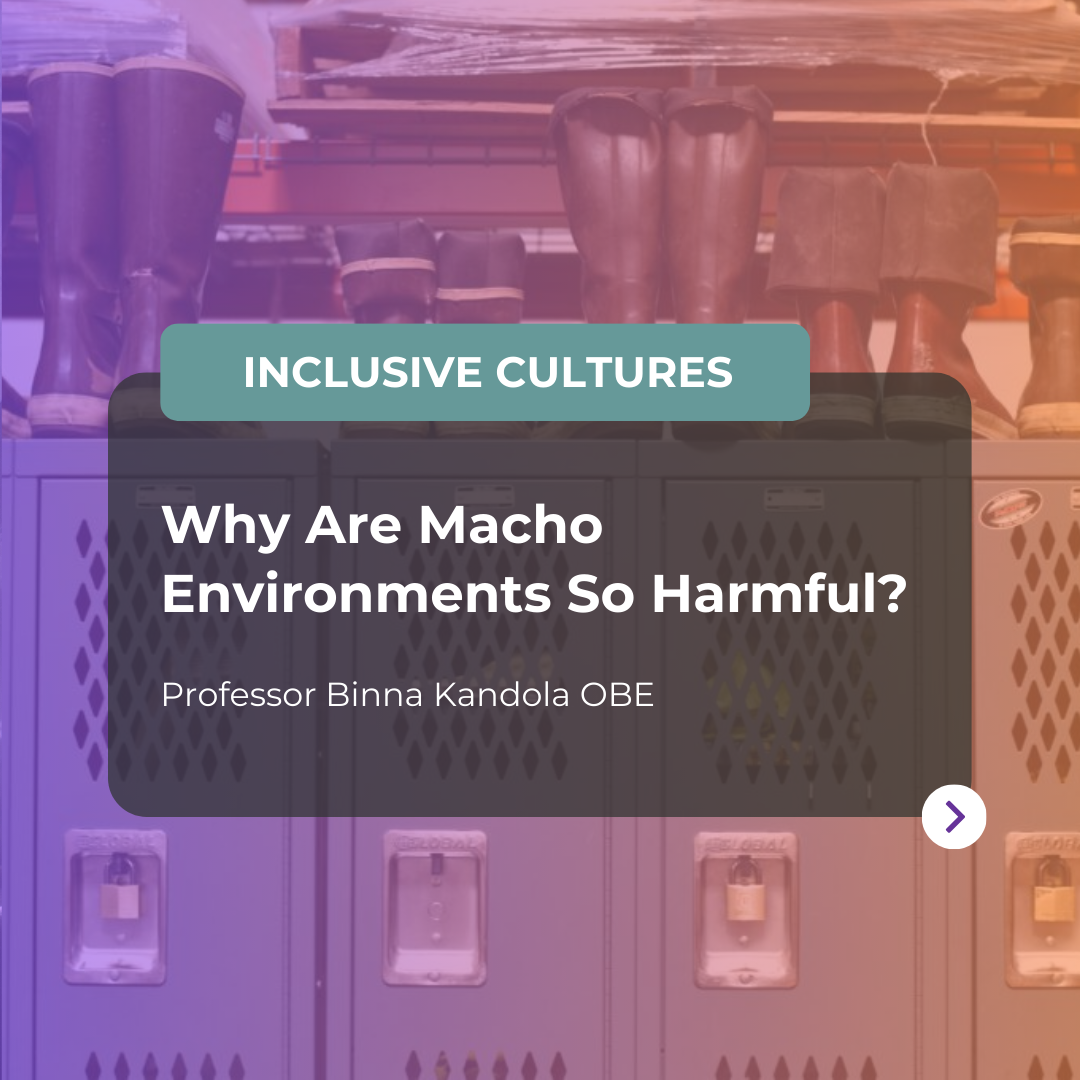
Why Are Macho Environments So Harmful article promo image

There’s been a lot of talk in the press recently about macho workplace cultures, with discussion often focussing in particular on uniformed professions such as the police.

During these conversations, we tend to home in on the dangers of such environments, how they can become breeding grounds for hostile behaviour and how we should strive wherever possible to avoid them.

But how is a macho culture created? What conditions are required for this kind of behaviour to become the norm? And what can we do to prevent it?

In what settings does macho behaviour thrive?

We tend to find macho behaviour in male-dominated organisations, often with very hierarchical structures and little representation of women at senior levels. This imbalance, in turn, paves the way for the sexist and derogatory attitudes that we so often associate with such environments.

But while macho cultures are certainly breeding grounds for sexism, it isn’t sexism that drives them. Instead, to be macho is more about a broader sense of dominance and authority. People bark at each other, fighting for their place. In order to keep up in a macho environment, you have to be macho yourself. As a result, these aren’t just harmful places for women. Everyone is under pressure, meaning that everyone is at risk.

It’s possible that the image or identity associated with certain professions plays a role in the creation of a macho culture. With the police, for instance, we talk about officers “fighting crime” and “protecting the community.” Even the commonly used label “police force” carries connotations of power and strength. No doubt they inform our expectations of the people working in those roles, of the power they should embody and the behaviour they should exhibit.

But while it’s often easy to pin macho qualities on uniformed services, it’s actually a much more pervasive problem. The construction industry, for instance, is a prime example of a hierarchical, male-dominated environment in which macho behaviour is required to survive and thrive. When we look at it solely in those terms, we immediately cast a much wider net.

Why is unacceptable behaviour tolerated in macho cultures?

One of the most harmful elements of macho culture, which is often the focus of the most ardent criticism, is the way inappropriate behaviour is tolerated. Sexist jokes and comments, for instance, are often dismissed as “banter,” and in time go from become normalised. The danger here, of course, is that when inappropriate behaviours become normalised, more extreme behaviours are likely to occur down the line.

This idea of tolerance – that behaviours which are inherently wrong are not only known about but are turned away from – often makes it even more troubling that macho cultures so regularly thrive in the organisations we look to for protection. To combat it, there have to be strict processes and clear procedures in place for colleagues to raise complaints in such a way that they, themselves, won’t be negatively affected. We also need leaders to set an example to the rest of the organisation, so that there is enough trust in the processes that colleagues will come forward with concerns.

There’s no denying how harmful a macho environment can be, and dealing with it won’t be an overnight task. But with the right structures and procedures in place, organisation can begin to make their workplaces safer and more inclusive.

If you think your organisation might need help putting these structures in place, please contact info@pearnkandola.com


Stay ahead of the game.

Get the latest on DEI, effective recruitment, and leadership development direct to your inbox.
This field is for validation purposes and should be left unchanged.
Privacy policy(Required)

Related Posts

  • Inclusive Cultures

The Cost of Silence: A case study for why employees stop healthy dissent  

Dissent. It’s a word that often makes leaders uneasy. According to the Oxford Learning Dictionary, it means “the expression of...
Announcing psychological safety week sponsored by the Financial Times presented by Pearn Kandola
  • Inclusive Cultures

BP, Cabot Credit Management, and Puma Capital Group Join as Sponsors for Psychological Safety Week

Global leaders support free international initiative to boost workplace inclusion, performance and trust BP, Cabot Credit Management, and Puma Capital...
Announcing psychological safety week sponsored by the Financial Times presented by Pearn Kandola
  • Inclusive Cultures

Charity for Civil Servants joins as sponsor for Pearn Kandola’s Psychological Safety Week

Psychological Safety Week, the first global initiative dedicated to empowering workplaces to be safe, inclusive and honest, is taking place...
  • Inclusive Cultures

Senovis joins Psychological Safety Week and Brings Renown AI Expert Ethan Mollick to Senior HR Leaders

As AI transforms work at speed, HR is becoming one of the most structurally important departments in the modern organisation....
Great Place To Work image featuring a stock image of a working professional and the title 'We're a UK's Best Workplace in Consulting and Professional Services 2025'
  • Inclusive Cultures

Pearn Kandola Makes The UK’s Best Workplaces in Consulting & Professional Services™ List

The 2025 UK’s Best Workplaces in Consulting & Professional Services ™ list was revealed this morning by Great Place To...
an image of various small plastic models to display a wide ranging team on a map, indicating inclusion
  • Inclusive Cultures

Building Trust with Inclusive Behaviours 

In today’s diverse and dynamic workplace, fostering an environment of trust is paramount for organisational success. Inclusive behaviours: actions that...

Free Consultation with a Business Psychologist

Talk to us to discuss your needs.
Book an Appointment
14 years’ experience
Jonathan Taylor, Managing Psychologist

Book Your Appointment Today

This field is for validation purposes and should be left unchanged.
(Required)
Terms & Conditions

Privacy Policy

Cookie Policy

Site map

Making The World Fairer

© 2025 Pearn Kandola LLP

© 2015-2024 Pearn Kandola LLP. All Rights Reserved.
Pearn Kandola and the Pearn Kandola Logo are registered trademarks of Pearn Kandola LLP.

  • About Us
    • About us
    • Careers
    • People
  • Services
    • Inclusive Cultures
    • Inclusive Recruitment
    • Inclusive Development
  • Resources
    • Insights
    • Research
    • Press
  • Case Studies
  • Contact Us
Search