Skip to navigation Skip to content

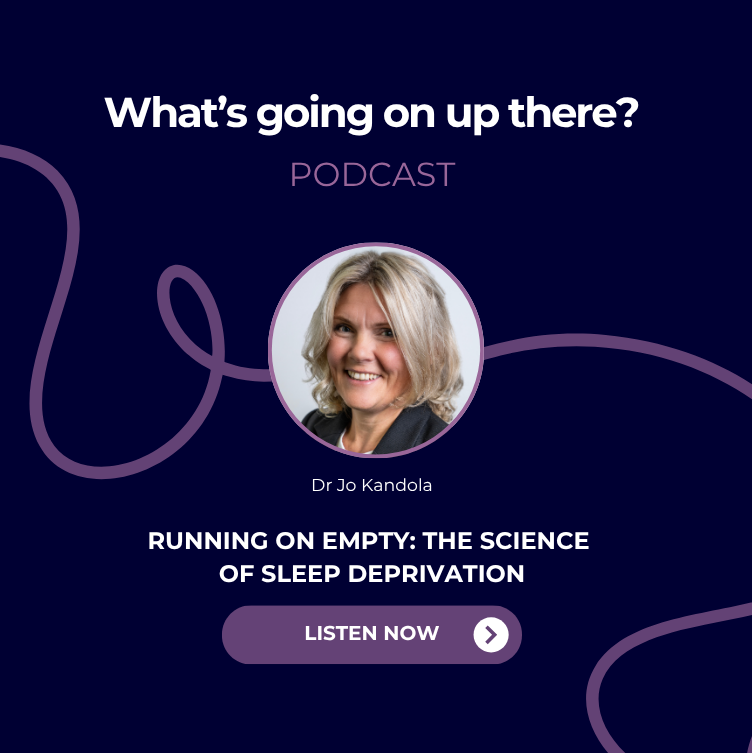
What’s going on up there? – Running on Empty: The Science of Sleep Deprivation

April 10th, 2026

Think sleep is just downtime? Think again.

It’s actually when your brain does some of its most critical work.

This week, Grace is joined by Dr Jo Kandola to explore the science behind what happens to your brain when you don’t get enough sleep.

Jo draws on extensive research to dispel common sleep myths and reveal the ways poor sleep affects how we think, feel, and function – from clouded decision-making and heightened irritability to its surprising impact on collective creativity. She also shares evidence-based tips to improve your sleep, starting tonight!

If you often talk yourself into late nights thinking you’ll be fine in the morning, this episode might change your mind.

References:
  • Killgore, W. D. S. (2010). Effects of sleep deprivation on cognition. Progress in Brain Research, 185, 105–129. https://doi.org/10.1016/B978-0-444-53702-7.00007-5
  • Harrison, Y., & Horne, J. A. (1999). One night of sleep loss impairs innovative thinking and flexible decision making. Organizational Behavior and Human Decision Processes, 78(2), 128–145. https://doi.org/10.1006/obhd.1999.2827
  • Banderet, L. E., Stokes, J. W., Francesconi, R., Kowal, D. M., & Naitoh, P. (1981). Artillery teams in simulated sustained combat: Performance and other measures. Proceedings of the 26th Annual Meeting of the Human Factors Society, 28–32.
  • Harrison, Y., & Horne, J. A. (2000). The impact of sleep deprivation on decision making: A review. Journal of Experimental Psychology: Applied, 6(3), 236–249. https://doi.org/10.1037/1076-898X.6.3.23
  • Li, J., Barnes, C. M., Yam, K. C., & Lian, H. (2019). Leader sleep deprivation and team creativity: The role of leader self-regulation and processing of creative ideas. Journal of Applied Psychology, 104(9), 1058–1073. https://doi.org/10.1037/apl0000397
  • Venkatraman, V., Huettel, S. A., Chuah, L. Y. M., Payne, J. W., & Chee, M. W. L. (2011). Sleep deprivation biases the neural mechanisms underlying economic preferences. Journal of Neuroscience, 31(10), 3712–3718.
  • Wild, C. J., Nichols, E. S., Battista, M. E., Stojanoski, B., & Owen, A. M. (2018). Dissociable effects of self-reported daily sleep duration on high-level cognitive abilities. Sleep, 41(12). https://doi.org/10.1093/sleep/zsy182

Stay ahead
of the game

Get the latest on DEI, effective recruitment, and leadership
development direct to your inbox.
This field is for validation purposes and should be left unchanged.